Septic System Installation and Design
Septic system installation requires careful planning, proper permitting, and skilled execution to create a wastewater treatment system that will serve your property reliably for 25-30 years. A properly designed and installed system protects groundwater, prevents property damage, and handles your household's daily wastewater safely. For rural properties lacking municipal sewer, a quality system is essential infrastructure that protects both property value and public health.
Georgia's red clay soil presents unique installation challenges. Unlike sandy coastal soils that drain freely, the dense clay drains slowly, requiring larger drain fields and specific system designs to meet state health department standards. Professional installation accounts for soil conditions, water table depth, property slope, and household water usage to create a system sized and positioned correctly for your specific site.
Our Complete Installation Process
- Site Assessment: We evaluate soil type, test drainage with percolation tests, measure slope, identify water table depth, and check setback requirements from wells, property lines, and water bodies.
- System Design: Based on site conditions and household size, we design a septic system that meets Georgia Environmental Protection Division standards. Design includes tank size, drain field configuration, and pipe layout.
- Permitting: We prepare and submit all permit applications to Toombs County health department, coordinate soil testing requirements, and schedule required inspections. Permit process typically takes 2-4 weeks.
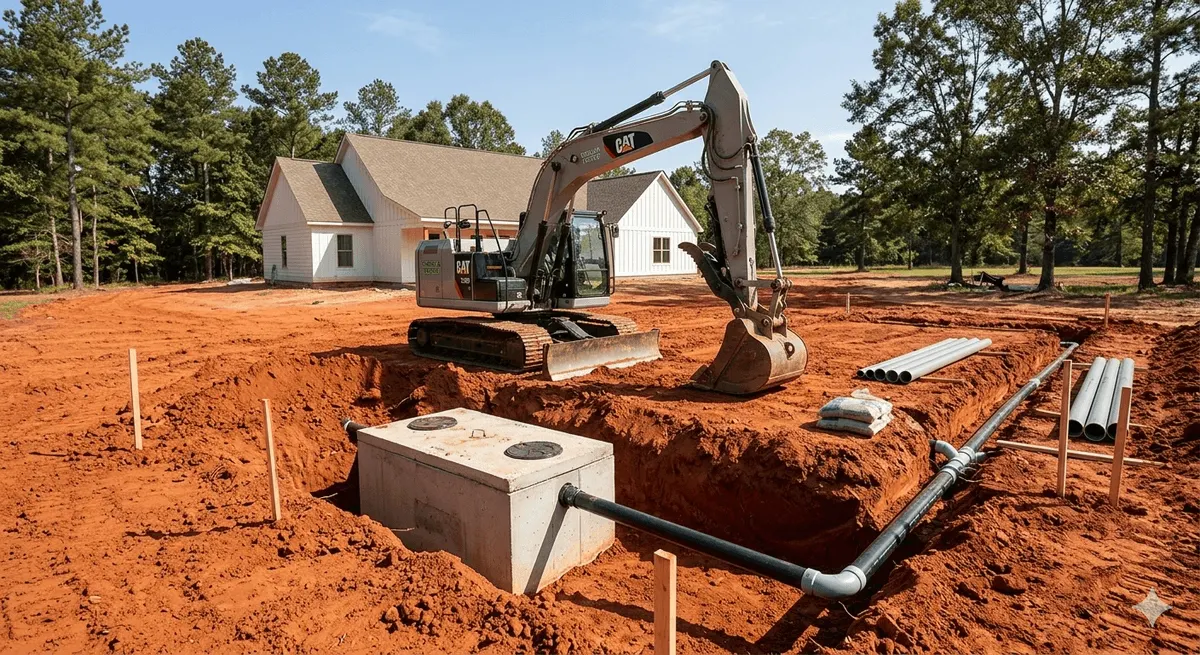
- Excavation: Using appropriate equipment for your site, we excavate the tank location and drain field trenches to proper depths. In clay soil, precise excavation depth is critical for system performance.
- Tank Installation: We set the septic tank level on a gravel base, ensure proper positioning for inlet/outlet pipes, and verify structural stability before backfilling.
- Drain Field Construction: We install distribution pipes at correct slope in gravel-bedded trenches, position pipes for even effluent distribution, and backfill with specified materials.
- Connections & Testing: All inlet pipes from the house, outlet pipes to drain field, and tank baffles are installed and tested before final inspection.
- Final Inspection: We coordinate the required health department inspection, address any concerns, and obtain final approval before covering and finishing the site.
Choosing the Right System Size
Georgia regulations base septic tank size on estimated daily water usage, which correlates to number of bedrooms. A 3-bedroom home requires a minimum 1,000-gallon tank, 4-bedroom needs 1,200 gallons, and 5-bedroom requires 1,500 gallons. Larger tanks provide more treatment time and reduce pumping frequency. We calculate the appropriate size during site assessment based on your specific home size, occupancy, and water usage patterns. Undersizing causes premature failure; proper sizing ensures decades of reliable service.
Drain Field Design for Georgia Clay
The drain field is the most critical and expensive component of your system. In clay soil, drain fields must be larger than in sandier regions because clay absorbs water slowly. Standard design uses perforated pipes in gravel-filled trenches that distribute treated effluent across a large soil area for final filtration. Poor soil conditions may require alternative systems like mound systems or aerobic treatment units. Our soil testing and percolation tests determine which system type your property can support, and we design accordingly to meet state approval.
Septic System Types Available
The soil conditions and site characteristics of your property determine which system type the Georgia Environmental Protection Division will approve:
- Conventional Gravity System: Wastewater flows from the house to a septic tank by gravity, then from the tank to a conventional drain field in gravel-filled trenches. Works well where soil percolation rates are adequate. Most cost-effective option when soil conditions allow.
- Pressure-Dosed System: Uses a pump to distribute effluent to the drain field in timed doses rather than continuous flow. Better suited to sites with slower soil absorption rates or where even distribution across a large field is needed.
- Mound System: Required when the natural soil has poor drainage, a high water table, or shallow bedrock. A raised mound of sand is constructed above the existing grade. Common on low-lying properties near wetlands or flood-prone areas.
- Aerobic Treatment Unit (ATU): An advanced system that uses oxygen injection to accelerate bacterial treatment of wastewater. Produces higher-quality effluent for difficult sites that won't support conventional systems.
- Drip Irrigation System: Uses small-diameter tubing buried just below the surface to distribute highly-treated effluent. Used on sites with shallow soils or poor percolation.
Our site assessment determines which system type meets Georgia EPD standards for your specific property and household size.
Georgia Septic Permitting Requirements
All new installations in Georgia require permits from the county health department. The process includes submitting system design plans, soil evaluation reports, site survey showing setbacks from property lines and water sources, and payment of permit fees. Multiple inspections occur during construction — before covering the tank, during drain field installation, and a final inspection before system activation. We handle all permitting steps and inspection coordination.
How much does a new septic system cost?
New septic system installation averages $10,000–$13,000 for a standard residential property. Sandy loam soil supports good drainage, but Georgia Rule 511-3-1 requires a soil evaluation, perc test, and EPD permit before any new system can be installed.